by Eric Steenstra
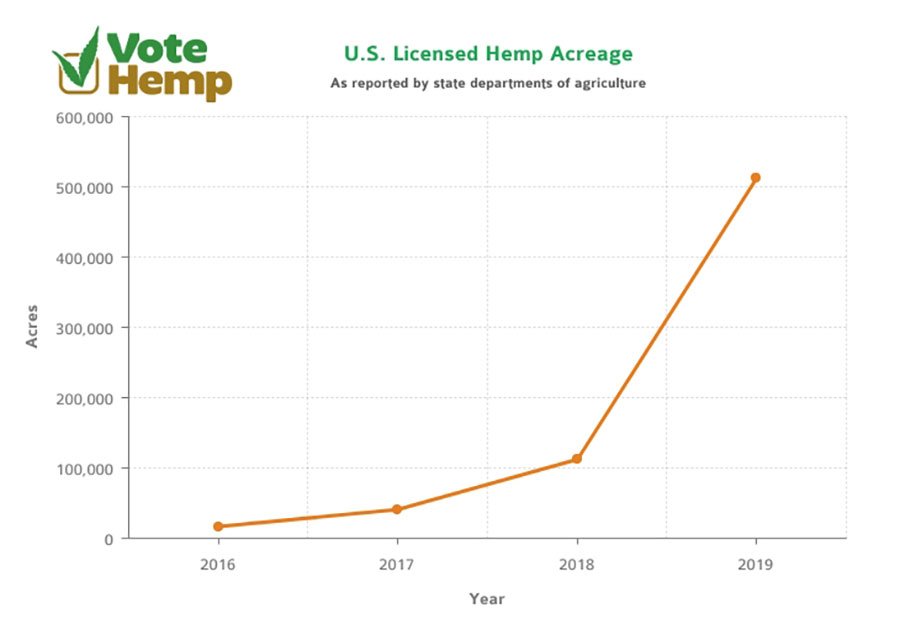
Licensed hemp acreage increased 455% in 2019 vs hemp acreage under license in the U.S. in 2018, based on new research by VoteHemp.com.
(View larger graph image)

Everyone seems to be talking about and using hemp products these days. Hemp extracts are suddenly available almost everywhere including your local supermarket, coffee shop and gas station. Hemp derived CBD and the benefits of the “entourage effect” from whole plant hemp extracts is driving a revolution in consumer health and it couldn’t come at a better time. Consumers are seeking natural alternatives to help them live healthier and happier lives. It also comes at a perfect time for the emerging hemp industry.
The legalization of hemp farming in the Farm Bill last December was a watershed moment for the hemp industry and for American farmers. The return of hemp to agriculture while farmers are seeking alternative crops created an intense level of interest in farming hemp and inspired literally thousands to enter the industry as evidenced by a massive increase in licensed hemp growers for the 2019 growing season. The Farm Bill also inspired thousands of new hemp processors and brands to enter the market.
Vote Hemp has been conducting an annual survey of state departments of agriculture since 2016 to track the growth of hemp cultivation in the United States. This year we are releasing a hemp licensing report first to document intent and will follow up with hemp planting and harvesting data once it has been reported. The results on licensing show more than 500,000 acres of hemp were licensed across 34 states, an increase of more than 455% over 2018 licensed acreage. Intent is a good indicator but we know from previous years that significantly less hemp is planted than what is licensed due to a variety of factors including access to seed and/or clones as well as inexperience. This will be the case again for 2019 and we estimate that 230,000 acres of hemp will actually be planted and significantly less harvested due crop failure.
Another important statistic is the growth in the number of farms that were licensed to grow hemp in 2019. Almost 17,000 licenses were issued for hemp cultivation in 2019, an increase of 477% over 2018 licensure. A significant amount of this activity is coming from new farmers which is good news for agriculture. In Tennessee alone, licensees increased by more than 1000% and many of them are small family farms. The number of family farms in the United States has been in steep decline for decades. Today, there are only about 2 million American farms in operation, down from nearly 7 million farms in 1935 and farmers are finding it ever more difficult to make a profit with traditional crops like corn, soy and wheat. Hemp is helping farmers to find new and more profitable markets and is encouraging new people to consider farming as a way of life.
However, hemp is not yet a commodity and while demand for biomass has been high, it is not yet clear what the total market demand will be for 2019 and 2020. Due to this uncertainty, I strongly recommend that farmers only grow hemp with a contract to sell it in hand and carefully vet their partners. It is also advisable to start with a small crop the first year as there is a significant learning curve. Bottom line, don’t grow more than you can afford to lose.
While farming alone contributed $132.8 billion to the US economy, the industry’s reach extends far beyond the soil. From the ethanol gas you recently pumped into your car to the IPA calling your name at the bar, countless products and industries rely on agricultural inputs to contribute value to the economy. Projections from the Hemp Business Journal show that hemp is likely to add at least $2.5 billion to agricultural output by 2022 and likely will continue growing at a fast pace for at least the next 5-10 years as demand grows for fiber and grain. The future is bright but there will be speed bumps along the road so drive carefully!
To learn more about the growing hemp industry, download our hemp licensing report. If you are looking for more in depth background on the best states for hemp cultivation, you may also be interested in the upcoming Hemp States Report I helped write for the Hemp Business Journal which should be released very soon.
 ERIC STEENSTRA
PRESIDENT, VOTE HEMP
Eric Steenstra is a hemp industry pioneer, co-founding hemp clothing and lifestyle brand Ecolution with Steve DeAngelo in 1992. Eric was a founding member of the Hemp Industries Association and served as HIA Executive Director from 2008 to 2016. Eric now serves as the president of Vote Hemp, the political advocacy organization that he co-founded and as Vice President of the California Hemp Council. He is a frequent speaker at industry conferences and trusted source to the media, including CBS, the New York Times, Forbes, CNN, Rolling Stone, Reuters and the Washington Post.
 Vote Hemp lead the effort to pass hemp farming legislation nationwide. In 2005, Steenstra worked with Congressman Ron Paul (R-TX) to draft the first modern U.S. hemp legislation introduced in Congress (H.R. 3037). In 2012 he worked with Senator Ron Wyden (D-OR) to get companion hemp legislation introduced in the U.S. Senate. Steenstra worked with Congressman Polis (D-CO) and Senate Majority Leader McConnell (R-KY) to have hemp legislation included in the 2014 Farm Bill. The 2014 Farm Bill authorized the first legal hemp farming in over 50 years and resulted in 78,176 acres of hemp being planted across 24 states in 2018. Vote Hemp also played an integral role in the passage of the 2018 Farm Bill including fully removing hemp from the Controlled Substances Act.