Tag: Black lives matter

  • Newsletter – June 25, 2020

    Newsletter – June 25, 2020

    Feature Article

    What’s Next for the Hemp Industry? Experience Hemp SUMMER SOLSTICE Virtual Conference & Expo Highlights Innovation, Call for Unity

    By Heather Collins

    2020 has been a pivotal year due to the coronavirus pandemic, which has made a tremendous impact nationwide and globally. These uncertain times have forced businesses, farmers, restaurants, and the hemp community to shift quickly and respond to safety concerns to protect industries.

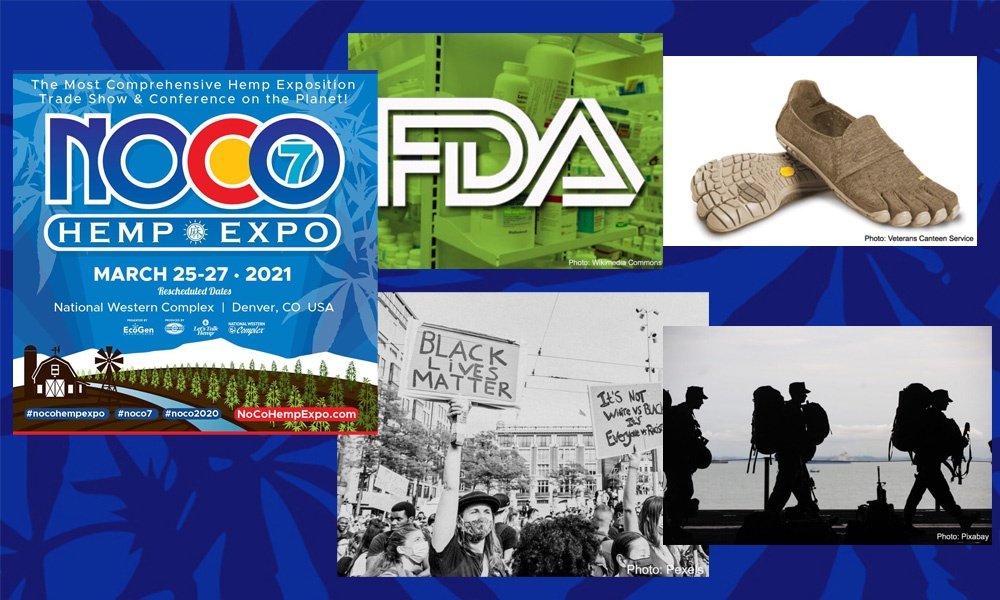
    The producers of the NoCo Hemp Expo and the Experience Hemp SUMMER SOLSTICE Virtual Conference & Trade Show made the hard decision to reschedule NoCo7 to the following year, which will now take place March 25-27, 2021.

    “The decision to reschedule NoCo7 was not easy, but we felt the need to protect everyone’s health and safety. This community is so collaborative. That’s what’s going to make this industry stand out as we look towards the future,” said Morris Beegle, Let’s Talk Hemp Media Co-founder and Producer of NoCo Hemp Expo. “We’re excited about in-person events, but until we get the green light, we will continue to plan virtual conferences that further educates and unites our industry.”

    Mark Reinders spoke on innovation at the Experience Hemp SUMMER SOLSTICE Virtual Conference and Trade Show, June 16-19, 2020. Register for free here to view live webcasts and a complete library of hemp market intelligence and information.


    NEWS BRIEFS


    HEADLINE NEWS

    Personal Care, Pharma Firm Perrigo Takes Stake in CBD Market with $50 Million Investment in Kazmira

    By New Cannabis Ventures

    Georgia Bill Passed; Raises Annual Fee for Hemp Processors from $10,000 to $50,000

    By The Atlanta Journal-Constitution

    Louisiana Governor Signs Bill to Ban Most Smokable Hemp Products

    By CBD Today

    Little-Noticed Hemp Memo Clarifies Military’s Ban On Service Members Using CBD

    By Marijuana Moment

    My Long-Lost Interview with Jack Herer, by Rick Cusick

    By The Drug Test News

    Profile: Winona LaDuke Turns to Hemp Farming, Solar Power to Jumpstart the Next Economy

    By The Star Tribune

    Profile: Hemp Farmer, Author Doug Fine Sees Great Potential in Still Misunderstood Plant

    By The News Station

    Bob Hoban in Forbes: CBD Has Never Been a Controlled Substance

    By Forbes


    FOOD AND BEVERAGE & SUPPLEMENTS

    Could CBM Be the Next Big Cannabinoid?

    By Cannabis.net

    CBD Beauty Brand Prima Receives B Corp Certification

    By ESG Today

    The Seed of an Idea: How Buckwheat, Hemp, Chia and Flax Are Taking Over

    By Entrepreneur Magazine

    Beyond the Trend: CBD-Infused Beverages Are Here to Stay

    By CBD Today


    FASHION, FIBER AND CONSTRUCTION

    Vital Hemp Founder Ron Alcalay Launches One World Mask Hemp/Cotton Face Masks

    By Vital Hemp

    Hemp is the New Asset in the Car Industry

    By Medical Cannabis News

    Study: Hemp Batteries Are More Powerful than Lithium and Graphene

    By Green Stories

    Eco-friendly Hemp Apparel Line Adds Social Media Influencers As Brand Ambassadors

    By The Green Market Report


    FARMING AND AGRICULTURE

    Producer Claims He Was First in State to Plant Hemp Seeds Since Texas Passed Law

    By KSAT TV San Antonio

    Colorado Submits State Hemp Management Plan to USDA

    By Colorado Department of Agriculture

    North Carolina Governor Cooper Signs NC Farm Act Without Hemp Provisions

    By Cannabis Law/Fox Rothschild

    Podcast: Unicorns in Oregon and Hemp in Hawaii

    By Lancaster Farming

    Five Things to Know About Indoor Grown Hemp Flower

    By Green Prophet

    Why 2020 Looks Like a Ghost Year for New York Hemp

    By Cannabis Wire


    INTERNATIONAL NEWS

    European Industrial Hemp Association Launches Novel Food Consortium

    By EIHA

    French Hemp Syndicate Issues Manifesto in Support of Nation’s Hemp Industry

    By HempToday

    Canada Company Ships Container Loads of Hulled Hemp Seed to South Korea

    By Daily Marijuana Observer

    Thailand Legalizes CBD and Kratom

    By CBD School News


    EVENTS

    Penn State Extension Hemp Webinar Series: Reducing Financial Risk in Hemp Production, June 29, 2020, 12:00 – 1:00 pm EDT

    Hemp Industry Deep Dive Virtual Global Tour, by Cannatech, Aug. 4, 2020, 12:00pm EDT

    NoCo Hemp Expo – NoCo7, March 25-27, 2021, National Western Complex, Denver, CO


    Read the Let’s Talk Hemp Summer Solstice 2020 Digital Magazine

    The hemp industry proves that, even in a world beset by pandemics and racial injustice, human and planetary healing can and will triumph. Read all about it in the Let’s Talk Hemp Summer Solstice 2020 Digital Magazine, produced in conjunction with the Experience Hemp Summer Solstice Virtual Conference & Trade Show, Let’s Talk Hemp Media, and NoCo Hemp Expo, in partnership with Honeysuckle Magazine.

    Featuring testimony from industry experts across diverse disciplines, Let’s Talk Hemp’s Summer Solstice edition dives into the pressing questions of the day. What is the future of hemp in a post-COVID world? What does Black representation in hemp look like, and how can we create opportunities for social equity? How can we take the next steps toward a regenerative society and integrative medicine? The answers may surprise you.

    Read the Let’s Talk Hemp Summer Solstice 2020 Digital Magazine Here.


    Order Your Copy of Doug Fine’s New Book, American Hemp Farmer

    American Hemp Farmer, the sixth book from author Doug Fine, follows the rigors and pleasures of an entire hemp season from soil preparation and genetics acquisition through harvest and regenerative marketing. It’s immersive. It’s wildly funny. The follow up to Doug Fine’s bestselling Hemp Bound, American Hemp Farmer pulls no punches, and because it is written by an actual hemp farmer and entrepreneur, it tells you what you need to know if you want to join the hemp renaissance.

    Order American Hemp Farmer Today

    Available at One Planet Hemp


    Subscribe to the Let’s Talk Hemp YouTube Channel

    #LetsTalkHemp is the ultimate platform that focuses on “Changing the Cannabis Conversation”. We provide news, education, and information about Hemp and Cannabis to our viewers so that they can learn more about the industry and get tips and tricks on the latest technologies. Subscribe to our channel and learn about everything from legal updates, farming, production, and new products entering the Hemp & Cannabis space.


    Podcast – Hemp for Our Future: Hemp Helps America

    Episode 36 of the Let’s Talk Hemp Podcast takes a look at how three amazing hemp leaders are bringing the industry together in an effort to help combat some of the issues resulting from pandemic pandemonium. Hemp for Our Future was the brain-child of Courtney Moran and Shawn Hauser, who brought in Annie Rouse and Friends of Hemp to organize and execute an ongoing campaign to gather supplies and help utilize hemp products to help America fight the war on COVID. In addition, Rick speaks with Kyla DuMont, the Vermont transplant to Los Angeles, that finds her path taking her back home as a result of the COVID economic relocation program. She describes the current state of the State of California, how she came up with the idea of MediMaple, combining cannabinoids with maple syrup, and how many folks didn’t realize maple came from a tree!

    LISTEN HERE


    About Colorado Hemp Company
    The Colorado Hemp Company, the producer of the 7th Annual NoCo Hemp Expo (NoCo7), is a leading organization for the advancement and advocacy of hemp farming, processing, production, innovation, education, and legalization in the USA. The entire team is committed to researching and developing alternatives so that hemp can once again thrive and help individuals and communities throughout America and around the globe. The 7th Annual NoCo Hemp Expo will take place August 6-8, 2020, at the National Western Complex in Denver, CO.

    Contact
    Steven Hoffman, Compass Natural, 303.807.1042, steve@compassnaturalmarketing.com
    Morris Beegle, Colorado Hemp Company, 970.541.0448, info@nocohempexpo.com

  • There Is Healing in the Soil: A Reflection on Being Black in Agriculture

    There Is Healing in the Soil: A Reflection on Being Black in Agriculture

    By Scheril Murray Powell, Esq.

    In February 2020, I spent time in Africa (The Motherland), in Jamaica (my MOTHER’s land), and at agricultural conferences and farms throughout the United States. At one point years ago, I had no interest in spending time outside, much less on a farm. However, when I became a part of the Cannabis industry, that all changed. Cannabis led me to Agriculture and encouraged me to embrace my Agrarian past. I have now come to love my time spent on farms around the world. So as I reflect on another revolution around the sun, I step fully into my profession as a Cannabis and Agricultural Attorney.  I have even come to refer to myself as an Agriculturalist.

    As a young child living in New York, I grew up enjoying my grandmother’s garden.  She planted tomatoes, mint, roses, and corn annually.  The cycle of planting season, harvest, and then the fall season was a part of my life, but I barely noticed it.  Once we moved to Florida when I started high school, my parents started to plant fruit and vegetables that they’d longed for from their past life in Jamaica. We had bananas, numerous citrus fruits, varieties of mangoes, Ackee (the Jamaican National Fruit), coconuts, June Plum, yams, and sugar cane growing in the yard. Each month represented a season of harvest for different plants. Though my parents had lived in the United States for decades, they had not forgotten the “goodness” of freshly grown food on your plate, especially if grown by your own hands. In contrast, I could not tell one tree from another unless the identifying fruit was in season. When I visited my family in Jamaica, there were chickens in the yard and goats traveling up and down the streets. However, I did not associate those animals with livestock farming; they were just my entertainment.

    Later in life, I found unexpected links to these memories within my Cannabis journey. As soon as I started participating in the cannabis community, I noticed the lack of diversity, especially with regard to the inclusion of brown people. The “Farm to Pharmaceutical” and “Farm to Bedside Table” movement did not reflect my community nor my heritage. Black people have been farming and feeding America for CENTURIES. Why then in this lucrative farming opportunity known as Cannabis, did I fail to see significant numbers of black people gaining cultivation licenses in my beloved industry? How did we get here? In order to answer that question, I explored my own relationship with agriculture and with the soil.

    The Trauma of Enslavement

    There is a lot of trauma associated with black people and the soil. Many of us associate farming and working in the soil with the historical period of enslavement. The image of black people toiling in the soil reminds us of oppression, forced labor, rape, and torture. Despite the gardens of my childhood, I was one of those people. But as I started to attend Black Farmers’ Conferences around the country, I noticed some alarming trends. The first trend is that black farmers were aging and I did not see enough of my generation or the next who were willing to follow in the profession. I also took note of the fact that there was not as much discussion of technological innovation at these conferences akin to those I saw in the mainstream conferences.

    I knew that part of my mission was to first address my trauma related to working in the soil and then encourage more black people to do the same, especially younger black people. Farming, bringing a seed to life, and stewardship of the land, are all important parts of our heritage that need to be preserved. I committed myself to spending more time on farmland, and as I did so, I fell in love with it. I started taking Agriculture certification classes offered for new farmers by Dr. Gilbert L. Queeley, PhD., at Florida A & M University so that I could be credible in my outreach to Black Farmers. At this point, I transitioned from being solely a Cannabis Attorney, to an Agriculture Attorney as well. I also changed my language about the era of enslaved people of the African Diaspora in the United States. In Ghana, I was reminded by Dr. Princess Asie Ocansey, a prominent member of the Ghanaian royal family and internationally-recognized business engineer and humanitarian activist, that Black people were never simply slaves. They were scientists, doctors, philosophers,  community leaders, teachers, mothers, sons, daughters, fathers, architects, builders, hunters, who were enslaved by people who would commit treacherous acts in order to have free labor.

    In my recent trip to Ghana, I got to put my feet in the water of the other side of the Atlantic, which would have been the last part of home seen by those who were enslaved and brought to America. I was also given my African name: the name that I would have had if my ancestors’ lives had not been disrupted by enslavers. By knowing my name – Ama (born on a Saturday) Serwe (beloved daughter of the king) – I felt a bit of fog clearing with regards to my identity. I could reposition the 400 years of enslavement and trauma as just a “pause,” allowing me to determine who I was meant to be and how  I was meant to contribute to my community. There is power in restoration and having a mindset of overcoming the past. And as we know, your past does not dictate or define your future.

    Trauma of Incarceration

    In the Black community of the United States, it is safe to say that everyone knows someone who was incarcerated for a cannabis-related crime. I often say that a Cannabis charge is the gateway to the prison industrial complex. As a result, it is difficult to initiate a conversation with a Black Farmer about growing Cannabis. This is also true for hemp, even though it was legalized and descheduled at the Federal level by the 2018 Farm Bill. When I speak to black farmers about growing Cannabis, there is a hesitation because our experience demonstrates that a person can be locked away for decades for just a joint.

    The Great Migration

    The HBO series The Watchmen opens with a scene of the brutal elimination of “The Black Wall Street” in Tulsa, Oklahoma through the massacre of 1921, known as the single worst event of racial violence in American history. Unfortunately, this was not an isolated occurrence in post-enslavement America. A self-sustaining community of black people was considered a threat. Lynchings were a common occurrence well into the 20th Century. As a result, many black people left their land, their Agrarian professions, and everything they knew in order to move North for safety and opportunity. Some spoke of their family’s history in the South, others never mentioned it again due to the pain, and their children knew better than to ask. We became detached from our love of growing food and the land.

    At one of the minority and small farmers conferences where I speak, I met Lillian “Ebonie” Alexander, Executive Director of the Black Family Land Trust, one of the nation’s only regional land trusts dedicated to the preservation of Black and other historically underserved landowners’ assets. Alexander did an excellent presentation detailing exactly what was lost during this migration. However, as is evident through the very existence of her organization, this relationship with the soil is still present in our DNA. I believe that is a huge contributor to the growing number of black people who are embracing Urban Agriculture in cities across America.

    The Decline in the Number of Black Farmers

    The most recent USDA census indicates that the percentage of Black Farmers is at 1.6%, which is not representative of the percentage of Black People in the American population. In 1920, that number was 17%. The trauma and migration discussed earlier partially explain why that number has not increased over time. Further explanations include the generational gap between older farmers with experience and the younger generation, in addition to the issue of the documented systematic elimination of black farmers due to access to capital issues and unfair practices.

    Despite these factors, I believe that cannabis can bridge that gap and create an “Agricultural Renaissance”. It is time for us to take back control over what we put into our bodies and how we nourish ourselves. So much of our well-being, health, and quality of life is tied to what we put into our bodies and the best way to control that is to grow your own. My mom refers to planting and nurturing her plants as therapy. I really believe that there is a level of healing that we as black people cannot tap into unless we reclaim our relationship with the soil and living things.

    Moving Forward

    When I speak at conferences around the world, I encourage people of color to get involved with growing their own food. If I, a person who barely went outside to witness the family garden, could become an Agriculturalist and hemp farmer, then anyone can restore their relationship with farming and the soil. An important part of this transition is finding available resources. I have learned the most by attending farming conferences, taking courses, and reaching out to extension programs of local Universities. I am now the Executive Director of the Black Farmers and Agriculturalists of Florida. This is not something that I would have predicted ten years ago. My consulting firm Green Sustainable Strong  works with farmers all over the world. My recent trip to Ghana has inspired me to incorporate contributing to the continent of Africa into our Agricultural Development Strategy.

    Black Farmers in this  country have always been a vital and necessary presence. They are not going to disappear on my watch.

    About Scheril Murray Powell

    Scheril Murray Powell is an Agricultural and Cannabis Attorney.  She is In House Counsel for Sunflora/ Your CBD Store.  She is the former Director of Federal Affairs for the Florida Department of Agriculture and current Executive Director for the Black Farmers and Agriculturalists of Florida. She is on the Board for the Hemp Feed Coalition and U.S. Hemp Roundtable.  She is President of Green Sustainable Strong, LLC, SMP Staffing, LLC, and Cannurban.com. Scheril is the recipient of the Crohn’s Foundation Blood, Sweat, and Tears Award and the Cannabis MVP Award from the Cannabis Business Award. She works on legalization efforts with leaders of Foreign Nations.