Tag: Bioplastics

  • 2nd Annual SLV Hemp Symposium Returns to Adams State University

    2nd Annual SLV Hemp Symposium Returns to Adams State University

    Bringing hemp education, economics, and environmental information to Alamosa Colorado and the San Luis Valley.

    Education is Power! Come network and learn from like-minded individuals in the hemp industry.

    As the hemp industry further demonstrates its potential to create new job markets, revolutionize our economy, and prove to be both nutritionally and environmentally beneficial, Colorado universities are realizing the need to incorporate hemp into higher education.

    The Second Annual San Luis Valley (SLV) Hemp Symposium will take place on Friday, November 10, on the (ASU) campus in Alamosa, Colorado. This year’s symposium, taking place in the Student Union building, is presented by International Hemp Solutions and features Let’s Talk Hemp, an all-day speaker series and exhibitor expo. The symposium covers a wide range of hemp topics including legislation and regulation, best farming practices, technology, hemp foods & nutrition, marketing your hemp business in today’s environment, and more. Panel members include industry experts and entrepreneurs such as, Tim Gordon from COHIA (Colorado Hemp Industries Association), Tom Dermody from Industrial Hemp Research Foundation, Alan Parsons from Power Zone, Morris Beegle of NoCo Hemp Expo, Bob Hoban from Hoban Law Group, Terry Moran from the Colorado Department of Agriculture, and Ryan Loflin, the first US farmer in 50+ years to successfully plant, grow, and harvest a commercial scale hemp crop in 2013 before it was federally allowed via the 2014 Farm Bill.

    Symposium host, ASU, illustrates the importance of having education and research grow simultaneously with infrastructure. Having launched their Industrial Hemp Initiative this July, ASU aims to create an SLV Viable Hemp Seed Program and to develop a large-scale, hemp-based economy in the San Luis Valley. The initiative focuses on what ASU President, Beverlee J. McClure, calls the four E’s: Economy, Environment, Education, and Entrepreneurship.

    Tickets are an affordable $10 for the Let’s Talk Hemp speaker series and free to walk through the mini-expo featuring 15-20 hemp based companies and organizations. Tickets are easily purchased on-line via the SLV Hemp Symposium TICKET SALES webpage.

    For more information visit the HempEvents.org website. Come join the movement while becoming educated by industry leaders.

  • 4th Annual Hemp Harvest Party!

    4th Annual Hemp Harvest Party!

    After 4 years the US hemp industry is finally starting to lose its baby-fat… Look how many more farmers and how many more acres of hemp were grown in Colorado and across the U.S. in just a single year!

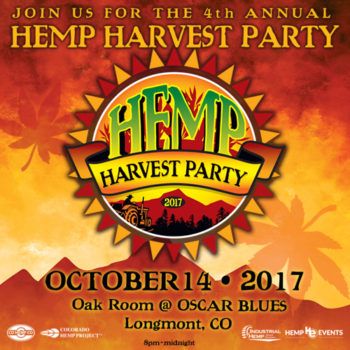
    At the 4th Annual Hemp Harvest Party, on Saturday, October 14th you can experience the living U.S. hemp movement in action, presented by Lilu’s Garden.

    Join industry leaders CoHempCo and Colorado Hemp Project as they host at the Oak Room at Oskar Blues Brewery in Longmont, CO, from 8pm-midnight to celebrate “an industry of trail blazers and leaders who have worked hard to accelerate the progress made during this year’s planting, growing and harvesting season.”

    Growers, processors, distributors, and even users are all pioneers in the hemp movement. Enjoy live entertainment with big screen hemp movies, network with hemp enthusiasts, and satisfy in amazing Oskar Blues beer flavors, hemp mulled wines, whiskey and vodka. Grab a special hemp cappuccino or latte from SteepFuze, and savor tasty hemp baklava desserts from Satya Creative.

    Meet Chef Kent of Z-Catering who will be creating special hemp-harvested goodies for purchase, featuring “Hemp Rocks” a German-style krautburger made with farm-to-fork fresh veggies and meats, spiced with a hemp-infusion, and topped with Colorado Hemp Company’s Hemp Green Chili. (Vegan and GF Options)

    The hemp industry itself is gaining weight quickly with more consistent planting of stable genetics; its firming-up muscle from another season of harvesting and processing; and more and more knowledge and experiences are gained and shared each day.

    The Oak Room is a wonderfully-warm event space with lots of tall solid tables, leather cushion booths, and high brewery ceilings. Purchase tickets today as this event is always a lot of fun and generally sells out!

    Right now, we are all pioneers in the movement. We are all leaders in our own individual hemp projects. We all have something to offer.

    Come celebrate and encourage each other as equals in the larger hemp community. For right now, the success of the community depends not on just one person, but on the endurance of all its members.

    Thomas Ivory, Jr.

  • The Rebirth of Industrial Hemp:   Processing and Bio-refineries 

    The Rebirth of Industrial Hemp:  Processing and Bio-refineries 

    Hemp is on the rise today, and facilities like Pure Hemp Technology and contributing to what Carl Lehrburger calls, “the thrust of the hemp revolution”. 

    By: Abbie Marks
    With the passing of the federal Farm Bill and supporting state pilot programs, local businesses are providing farmers an opportunity in industrial hemp while manufacturing eco-friendly products.

    Pure Hemp Technology, a hemp processing plant and bio-refinery located in Fort Lupton, CO is doing just that, promoting sustainable agriculture by converting industrial hemp into useable products.

    As of last year, Colorado Department of Agriculture reported 3,675 acres of hemp grown in 2016, nearly tripling in volume of growing space and in number of participants last year. According to the National Hemp Association, hemp farming nationwide grew 1,000% in 2015.

    Hemp farmers are driving the demand for companies like Pure Hemp Technology to process hemp today.

    In this video with Ed Lehrburger, Founder of Pure Hemp Technology and Dani Billings, Co-Founder  of Colorado Hemp Project and Nature’s Root discuss the role of the hemp plant in Colorado’s’ booming agricultural economy.

    “Processing represents the thrust of the hemp revolution.” –Carl Lehrburger, Executive Manager of Pure Hemp Technology

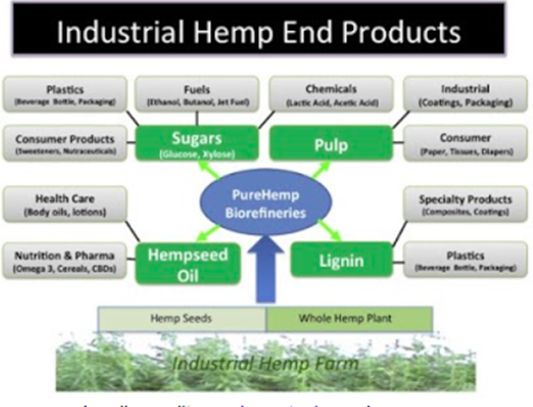
    Pure Hemp Technology is a wet processing plant which distinguishes them in their approach and represents a key “central supply chain” that simply doesn’t exist for whole plant processing.

    industrial-hemp-blog
    (media credit: www.purehemptech.com)

    This allows plants like Pure Vision to refine hemp into higher value products and strains in addition to fiber, pulps for paper, and other materials like lignin which consists of 20% of the plant. These materials  are processed into several applications from chemicals and plastics to sugars, sweeteners, alcohol, and more.

    Pure Vision/Pure Hemp Technology is a registered R&D facility in Colorado, producing different grades of pulps and stalks/hurd, long fibers, into useful products for green businesses.

    Processing these co-products into these higher value products is critical to growing hemp.

    “A company looking into textiles, processing, seed, etc, that only represents a fraction (of the market value),” says Lehrburger, “it makes growing it (hemp) more valuable (for American farmers).”

    Facilities like Pure Hemp Technology provide farmers a means to commodify their harvest as well as readily available sustainable alternatives and to everyday consumer goods.

    “Farmers have to be successful, pricing of commodities has to also be successful to buy seed, specialized equipment, etc.”

    In light of the decline in opportunity and the challenges faced by Rural American farmers today, Lehrburger discussed the potential for jobs not only in the growing and agricultural sectors but in processing and manufacturing.

    “The start of the hemp industry seems to represents a significant opportunity for revitalizing rural America, where the bigger picture is replacing oil-based products with bio-based products.”

    In this article from Environmental Health News, Jessica Knoblauch reports that “evidence is mounting that the chemical building blocks that make plastics so versatile are the same components that might harm people and the environment. And its production and disposal contribute to an array of environmental problems.” 1.

    Supporting the Industrial Hemp Farming Act, urging businesses to consider go green, and reaching out to congress is a huge push away from plastics and a way to help surge the rebirth of industrial hemp.

    For more information on hemp processing and bio-refineries like Pure Hemp Technology, join Ed Lerhburger and Carl Lerhburger at NoCo Hemp Expo on April 1-2 at The Ranch Events Complex in Loveland, CO. Ed will be speaking at the Let’s Talk Hemp stage along with several key industry experts and business leaders during Saturday, April 2. To learn more about the expo and view a full schedule of events click here!

    1. Knoblauch, Jessica A. “The Environmental Toll of Plastics.” Environmental Health News. N.p., 2 July 2009. Web. 30 Mar. 2016.


  • Driving Hemp into the Future:  BMW Goes Biodegradable

    Driving Hemp into the Future: BMW Goes Biodegradable

    Lighter-weight, fuel-efficient vehicles with hemp are right down the road.

     By: Brad Shannon

    Why use hemp to make automobiles? For a number of reasons. Hemp is lighter than steel or fiberglass, resists dents and is not brittle like carbon fiber, and it is biodegradable. Most importantly, hemp is carbon negative, says Bruce Dietzen of Renew Sports Cars.

     hemp-car1
    (BMW door panel – media credit: Redspiderfish/Flickr)

     Work is ongoing in Australia and Europe to create plant-based materials to replace parts that today use plastic and metal. A reduction in weight of 30% for such parts provides an instant boost in fuel economy, with a higher strength-to-weight ratio than steel. When it reaches the end of its useful life, just bury it and let it biodegrade.

    You may have come across the story of Henry Ford’s hemp car online. Unfortunately, it seems that there is a lot of myth to that tale, according to The Angry Historian – at least when it comes to how much of the car was actually made of hemp. Rather, the plastic body panels used standard resin binder combined with natural materials such as hemp fiber as fill material. That popular image of Ford taking a whack at a car with an axe? It was a soybean-based material.

    hemp-car2

    (media credit: Ford archives)

     A sleeker, safer, faster modern take on a hemp car is a slick sports car built on a Mazda Miata chassis by Dietzen. The car’s body is made of hemp, and runs on biofuel that is a closed carbon loop in that it does not add any new carbon to the atmosphere when burned. It made an appearance down the road from us in Denver late last year. The next big step, it appears, could be vehicles with 3D printed hemp bodies; but some find it hard to beat the Lotus Eco Elise prototype from the 2008 British Motor Show, or the i3 and i8 concepts from BMW that incorporated hemp.

    hemp-car3
    (media credit: Renew Sports Cars)

     If you’re like most, though, your budget may run more along the lines of the electric Kestrel with hemp body panels promised by Calgary, Canada-based Motiv Industries (a neighboring market with more enlightened views on hemp cultivation that puts companies there at an advantage).

    hemp-car4
    (media credit: Motiv Industries)

      Not ready for a hemp-based car body? How about a nicer, more natural interior? Mercedes led the industry with jute-based door panels in its E-class, and BMW and Audi VW have followed in the use of plant fibers in their vehicles.

    hemp-car5
    (media credit: Lotus)

     Learn more about hemp and its future in the automotive and other industries from a wide variety of experts at the NoCo Hemp Expo 2016 at The Ranch Events Complex in Loveland, CO April 1-2.


  • The Stage is Set! Industrial Hemp Expo Unites Global Participants 

    The Stage is Set! Industrial Hemp Expo Unites Global Participants 

    Sponsored By Game Changers: Seed CX

    The Time is Now to Sow the Seed


    Are you ready for the largest hemp event in North America?


    Opening Ceremonies begin Friday, April 1st at 10 AM at The Ranch Events Complex in Loveland, CO. The NoCo Hemp Expo, now in its third year,  is the place to be for all things hemp. Colorado Hemp Company is honored to bring together the most experienced thought leaders from around the globe. 


    On April 2, stop by the Colorado Hemp Company Booth from 2-3 PM for your very own hemp-printed Declaration of Independence or pocket Constitution and have it autographed by our special guest Ben Franklin, Christopher Lowell.  Visit the Let’s Talk Hemp Stage as he shares his knowledge of hemp in the U.S from the perspective of one of our nation’s brightest inventors and leaders.Inline image 1


    Did you know? Benjamin Franklin’s discovery of the electric current set in place the building blocks to modern electricity as well as many modern terms and applications still used today like the battery.

    You won’t want to miss the myriad of hemp activities happening at NoCo Hemp Expo this weekend! Speaking on Processing and Technology, Doug Fine joins Pure Hemp Technology’s Ed Lehrburger and other knowledgeable panelists for an in-depth look into the future of hemp. From bio-refineries to hemp super capacitors, the applications for the hemp plant are endless and will be discussed at NoCo3. 


    Learn how to juice using hemp with professional Chef and Certified Biofeedback Specialist Cece Stalter of CBDRx. Take a glance into health, wellness, and nutrition with panelists like Dr. Bob Melamede, Ph.D. Molecular Genetics and Biochemistry and sample some of Ari Sherman’s Evo Hemp bars. 


    Join the fun with paper-making and hemp building workshops and more at the Quicksilver Scientific Stage. Embrace the world of quality hemp products from over 130 exhibitors at the expo or attend  a panel on U.S. made products featuring Dani Billings, Founder of Nature’s Root and Summer Star-Haeske, Owner/Co-Founder of EnviroTextiles. 


    Stick around for Keynote Speech from Doug Fine on The State of The Hemp Industry in 2016 and a message from Ben Franklin on Patriotism, Life, Liberty, and the Pursuit of Happiness happening at 4:00 PM in the Let’s Talk Hemp Theater.  


    Closing out NoCo3, Rep. Jared Polis will be delivering the Call to Action and speaking on the state the hemp industry in terms of in-state and federal legislation as well as the economic opportunities available in hemp. Polis and his Staff have been championing for hemp since the inaugural NoCo Hemp Expo was first produced in 2014. Come learn more about the state of hemp and be a part of the movement happening throughout the U.S. 


    Click here for a live schedule of the event. Purchase your tickets today before prices go up on Friday at the door! Enjoy a weekend dedicated to  hemp with live entertainment, hands-on activities, art, networking, and more at #NoCoHempExpo and be sure to check out the live HempWall where you can connect your message with everyone at the expo. 


    About NoCo Hemp Expo, Colorado Hemp Company and TreeFreeHemp

    WAFBA LLC (We Are For Better Alternatives) is home to the NoCo Hemp Expo, TreeFreeHemp and Colorado Hemp Company located in Loveland, Colorado and operating since 2012. Areas of focus include product and brand development, marketing, printing, production, events and advocacy.


    Press Contact: Abbie Marks 

    (985) 518-7493

    abbie@nocohempexpo.com 

  • The Future of Sustainable Building:  Eco-Friendly Insulation, HempCrete and More

    The Future of Sustainable Building: Eco-Friendly Insulation, HempCrete and More

    John Patterson of Tiny Hemp Homes and Joy Beckerman of Hemp Ace International describe how hemp is an ideal material for construction and see its application in commercial and home building growing in 2016.

    By: Brad Shannon

    Hemp as a building material has roots that stretch back millennia. Buildings constructed thousands of years ago using hemp still stand today at Ellora Caves in India, a testament to the plant’s suitability and durability as a construction material.

    “Hemp as a building material is not a new idea,” notes Joy Beckerman of Hemp Ace International. “It’s an ancient trend proven over thousands of years, and there’s no need for new research to find ways to use it – we already know.”

    Including the long list of benefits from green building, the versatility and sustainability of hemp is perhaps best showcased in the myriad ways it can be used as a building material today.

    John Patterson of Tiny Hemp Houses notes that “A hemp wall replaces the combination of drywall, insulation, exterior boarding, house wrap, siding, caulk and paint all in one thermal wall system. It’s great at keeping a more comfortable constant temperature, is fire resistant, breathable, mold-, pest- and mildew-resistant, and over time extremely affordable.”

    This helps create a home where, as Sergiy Kovalenkov’s company Hempire UA notes, hemp insulation and a high thermal mass helps regulate temperature and humidity to reduce heating and cooling costs; hemp materials create naturally vapor-permeable walls reduce or eliminate the need for ventilation; and hemp helps create a quiet living space that is non-flammable, resists mold and mildew, and repels pests. Using natural materials eliminates the possibility of toxic off-gassing from manmade materials, which could have a positive impact on our health.

    tiny-hemp-home1
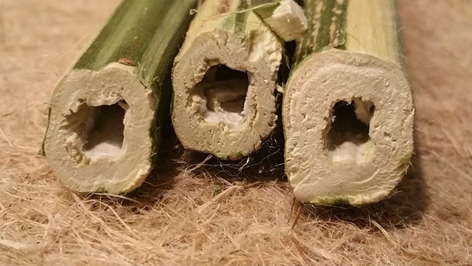
    (Hemp stalks showing the interior hurd media credit: HempCrete WorkShops)

    Beyond being a versatile building material, using hemp for building is also good for the earth. Growing hemp helps not only reduce CO2 emissions, but actively removes CO2 from the air.

    tiny-hemp-home2
    (Hemp hurd ready for use media credit: HempCrete Workshops)

    Tiny Hemp Homes notes that industrial hemp is only grown on about 100,000 hectares globally, producing a crop valued at about $600 billion across industries that use hemp as a raw material.

    That market will no doubt grow in the footsteps of what Beckerman describes as “a tremendous surge in projects globally and in the U.S., including commercial projects like the Marks & Spencer Cheshire Oaks store and The Triangle Project, a 40-unit housing complex, both in the UK. They use much less energy than traditional construction, and that is one thing that is making this something that is not just for tiny homes or pods.”

    tiny-hemp-home3
    (HempCrete, Hemp Insulation, and Hemp Chip Board media credit: HempCrete Workshops)

    Learn more about building with hemp from local, national, and global experts like Frank Wetenkamp, a Natural Building Professional with Tiny Hemp Houses, Joy Beckerman of Hemp Ace International, John Patterson of Tiny Hemp Houses, Sergiy Kovalenkov of Hempire UA, David Neisingh of Reakiro Labs, Anndrea Hermann of Hemp Technologies and many others at NoCo Hemp Expo 2016 at The Ranch Events Complex in Loveland, CO April 1-2.

    In particular, don’t miss the Building with Hemp sessions featuring all of these folks in a panel discussion. Plan to catch one of these sessions:


    April 1

    Hempcrete Mixing with a Natural Plaster Finish
    1:00 to 2:30 pm on the Quicksilver Scientific Workshop Stage

    April 2

    Hempcrete Mixing with a Natural Plaster Finish
    Noon to 1:30 pm on the Quicksilver Scientific Workshop Stage

    2:45 to 3:25 pm in the Hemp Business Journal Summit Room

    tiny-hemp-home4(media credit: HempCrete Workshops)

  • How Building With Hemp Can Help Curb Climate Change

    How Building With Hemp Can Help Curb Climate Change

    Between the manufacture of building materials, transportation of those materials and construction equipment, energy use and worker transportation, along with the final disposal of construction waste, the United States building sector is becoming one of the world’s largest threats to climate change.

    Did you know?

    • Half of the world’s energy goes into buildings throughout their lifetime – from construction, through use, and finally demolition.

    • Buildings, and the construction and use of those buildings, also contribute to almost half of the world’s carbon dioxide emissions.

    • Transporting the materials to a building site constitutes 6-8% of total greenhouse gas emissions for a project.

    • Construction is one of the largest consumers of raw materials, using 25 percent of the world’s timber.

    • The manufacture of concrete and reinforced steel account for 94-95% of greenhouse gas emissions for construction materials.

    The U.S. Green Building Council reports that not only does the United States commercial and residential building sector consume 70 percent of electricity, but accounts for 39 percent of all CO2 emissions produced. In fact, U.S. buildings alone are said to be responsible for more carbon emissions annually than those of any other country, except China.

    Hempcrete is made of the inner woody core of the hemp plant (called shiv or hurd) mixed with a lime-based binder and water. It is environmentally friendly, non-toxic, energy-efficient and resistant to fires, mold and insects.

    Hempcrete, and other hemp building materials, have the ability to transform the building sector into a more energy-efficient and climate-friendly industry, playing a major role in reducing our ecological footprint. Here’s how.

    Manufacturing

    The manufacture of concrete and reinforced steel accounts for 94-95 percent of greenhouse gas emissions produced from construction materials. These materials are often made using poisonous chemicals and continue to release toxins into the environment even after the buildings are constructed.

    Contrary to these traditional construction materials, hemp is typically a low-maintenance, fast-growing agricultural crop that thrives in both temperate and tropical climates. While it grows, it absorbs carbon emissions and helps replenish the soil with nutrients. Once mature, it can be harvested and processed into a concrete-like mixture called hempcrete.

    Hemp processing is much less destructive to the environment than traditional concrete production. It requires less energy to produce, and it is a sustainable, annually renewable industrial resource.

    HempFlax is a company focused on the production and processing of sustainable resources, semi-finished and finished products made from ecologically grown fibre hemp and flax. They discourage unnecessary logging and deforestation by producing hemp wood for paper, construction material, sawdust and many other environmentally damaging consumer goods.

    Transportation

    Manufacturing building materials that are then transported to a building site to be constructed into a final structure, all emit large amounts of greenhouse gases and consume increasing quantities of energy. To reduce transportation costs and increase efficiency, hemp is often grown in close vicinity to the production facilities.

    On farm processing methods have also been explored in an effort to decrease these costs. Hypothetically, all processing and transportation equipment could run on hemp biodiesel – but that’s down the road.

    Pictured above: The Nauhaus Prototype Project, a hempcrete home in Asheville, North Carolina. Click here to learn more about our stay in The Nauhaus!

    Construction

    Hemp can replace traditional construction materials like concrete, timber, and steel with applications like hempcrete and other hemp-based construction materials like hemp fiberboard and hemp insulation.

    Hempcrete is lightweight, non-toxic, and biodegradeable. It is usually mixed on-site, although precast walls and blocks are also available. Building with hempcrete offers design flexibility, because it has the ability to form around any shape, then set and support its own weight.

    Energy Usage

    A significant amount of emissions come from the combustion of fossil fuels to provide heating, cooling and lighting, and to power appliances and electrical equipment. Hempcrete regulates temperature and humidity; in some cases completely eliminating the need for heating and cooling systems, resulting in noticeable energy savings.

    “Hempcrete is used as an environmental barrier for providing resistance to heat transfer and managing moisture of the building envelope,” says Kris J. Dick, an associate professor in the Department of Biosystems Engineering at the University of Manitoba in Winnipeg and director of Alternative Village, its construction research facility. “Engineers and architectural designers practicing in the field of nonconventional material applications have clearly indicated a need for more design data regarding hempcrete.”

    As time passes, the strength of hempcrete has shown to increase. The lime-binding agent that is mixed with the hemp hurd calcifies and gets harder over time. The average hempcrete building is expected to last several hundred years.

    Pictured above:  John Patterson from Tiny Hemp Homes showing Kentucky Hempsters, Kirstin Bohnert, his latest project in Berthoud, Colorado. Click here to learn more about our visit with John and his Tiny Hemp Home in CO!

    What to learn more about Hempcrete?


    Industry leaders and experts will gather together on April 1-2 in Loveland, Colorado for the NoCo Hemp Expo, the largest hemp-centric event in the country. Join John Patterson and Frank Wetenkamp from Tiny Hemp Homes for a “Building with Hemp” workshop from 1:00 pm – 2:30 pm on April 1 or 12:00 – 1:30 pm on April 2.

    Be sure to sign-up for our mailing list for future hempcrete building workshops this season!

    —

    Sources

    Image source (top): https://www.facebook.com/alembicstudio/photos/a.1018396308179468.1073741829.150498734969234/1138901149462316/?type=3&theater

    https://helix.northwestern.edu/blog/2011/03/construction-has-costly-carbon-footprint

    http://www.huffingtonpost.com/2012/05/10/hempcrete-hemp-house_n_1506662.html

    http://www.eesi.org/files/climate.pdfhttp://www.collective-evolution.com/2013/02/03/hempcrete-worlds-strongest-building-material/http://hempflax.com/en/what-is-hemp/hemp-processing

    https://www.asme.org/engineering-topics/articles/construction-and-building/green-alternative-to-insulation-materials

    http://hempflax.com/
  • 3rd Annual NoCo Hemp Expo to Host Hemp Investment Summit

    3rd Annual NoCo Hemp Expo to Host Hemp Investment Summit

    Presented by: The Hemp Business Journal

    Tickets are on sale now​​ for the largest hemp‐centric Trade Show and Conference in North America. With over 100 exhibitors, 50+ speakers and industry experts, 2016 is gearing up to be one of the most important years in history for the industrial hemp movement.

    April 1‐2 at The Ranch Events Complex in Loveland, CO will feature an assortment of fun‐filled workshops and program add‐ons including “Let’s Talk Hemp” and “The Hemp Investment Summit” presented by the ​The Hemp Business Journal.​

    “We are excited to have the first‐ever nationally hemp‐focused Investment Summit as part of our conference. Our partners at The Hemp Business Journal and ​Business Catapult​ are bringing together the investment sector and investment ready companies throughout the hemp industry with the potential for funding right off the expo floor.”

    —Morris Beegle, ​Founder @ NoCo Hemp Expo

    The investment summit marks a significant shift toward entrepreneurship and professional development in the hemp industry. Access is strictly limited to 65 attendees, so click ​here​ to reserve your VIP ticket today or to register as a founder or accredited investor.

    “All the World’s a Stage,” says Morris, “ and in the Hemp world today, there is no bigger stage than The NoCo Hemp Expo. “

    Hemp advocates, business leaders, state officials, and educators will assemble together for a weekend of education, entertainment, innovation, commerce, and All Things Hemp!

    Invest in progress this spring by attending the third annual NoCo Hemp Expo and join in the excitement of this emerging industry.

    Abbie Marks
    On The Mark PR
    (985) 518-7493
    abbiemarkswriting@gmail.com